

Playgrounds and school grounds in robinia: what the EN 1176 standard really says

Robinia series · Choosing by use
A naturally durable timber, and a standard that talks about safety, not species
In a playground, a child grips the wood with both hands, puts it in their mouth and falls on it. Robinia — also known as black locust, and often sold as acacia (Robinia pseudoacacia) — answers through its composition alone: its heartwood — the wood at the centre of the trunk, as opposed to the sapwood, the pale outer ring — reaches durability class 1-2 (EN 350) and holds use class 4 (EN 335), permanent ground contact, with nothing but the wood itself.
The EN 1176 standard governs the safety of equipment — strength, entrapment, edges, inspections — and leaves the choice of material to the client: no standard prescribes a species. A robinia post set in the ground lasts around 30 years, against about ten years for use class 4 pressure-treated pine.
~30 years, with the wood alone
Service life of a robinia post in ground contact, against about 10 years for pressure-treated pine.

Why is a naturally durable timber the right choice where children play?
A playground is the only outdoor structure whose material gets bitten. Children put their hands in their mouths, hang on to uprights and fall onto low parts. Then there is maintenance: sanding out a splinter produces wood dust, breathed in by the grounds staff and by the children who come back to play.
Robinia needs no metal salts to last outdoors: its resistance to fungi comes from flavonoids and tannins spread throughout the heartwood, which EN 350 places in durability class 1-2. One condition can be checked by eye on every piece: the sapwood, which is not durable, must be removed entirely. It is the same reasoning as for raised beds — see “Vegetable gardens, raised beds and edging – robinia in ground contact”.

What does EN 1176 really require — and does it prescribe a species?
EN 1176 is a safety standard for equipment, not a list of approved species. It is a series: Part 1 sets out general requirements and test methods, Parts 2 to 6 cover swings, slides, cableways, carousels and rocking equipment, Part 7 is the guide to installation, inspection and maintenance, and Parts 10 and 11 deal with fully enclosed equipment and spatial networks. A separate standard, EN 1177, covers impact-absorbing surfacing and critical fall height.
What the series governs is geometry and mechanics: strength of the equipment and its foundations, no sharp edges, protrusions or splinters on accessible surfaces, dimensions that avoid head, finger and clothing entrapment, stability, and safety zones. No part names robinia, and national playground regulations do not prescribe a material either (in France, for example, decrees 94-699 and 96-1136): robinia comes in through the client's technical specification.
Robinia or pressure-treated pine for a public playground?
Use class 4 pressure-treated Scots pine is accepted in playgrounds, and much equipment that complies with EN 1176 is made from it. Its durability comes from a treatment, not from the wood: copper salts injected under pressure into the sapwood, the only part the product penetrates. Pressure-treated timber therefore slowly leaches copper, and every drying split opens an untreated face at the core of the piece.
End of life separates the two materials: pressure-treated timber goes into the waste stream and must not be burned, whereas robinia ends up as firewood — see “Is robinia an ecological timber?”. Pine wins, on the other hand, on three points: a much lower purchase price, long straight calibrated lengths, and availability almost everywhere at short notice.
Criterion | Robinia (heartwood) | Pressure-treated pine, use class 4 |
Source of durability | The wood itself: durability 1-2 (EN 350) | Copper salts in the sapwood |
Service life in ground contact | ~30 years | ~10 years |
Drying split | Durable to the core | Exposes an untreated face |
End of life | Firewood | Waste, do not burn |
Price, straight lengths | Dearer, rarer | Pine wins |
Bark, sanding, splinters: how do you recognise well-prepared playground timber?
A post intended for a playground leaves the mill sanded or turned, with arrises broken, fully debarked and with the sapwood removed. At our sawmill in Teiu, Hunedoara County (Romania), debarking is followed by a pass with an abrasive disc that smooths the surface and evens out the cross-section. A sanded log nevertheless keeps the shape its growth gave it, to within ± 1 cm: if your equipment needs a controlled dimension — for an entrapment gauge, drilling to a drawing or a joint — ask for milled posts, calibrated to the millimetre from 12 to 25 cm in diameter.
The fresh bark and green parts of robinia contain robin, a toxic protein that is well documented in horses. Debarked wood, on the other hand, is inert: this is why a robinia stake is used without reservation in pasture. The toxicological detail is in the FAQ of “Robinia fencing and cleft palings – choosing by use”. A specification should therefore require fully debarked pieces, with no shreds of bark left in the knots.

That leaves bare feet, which come up at every meeting about school grounds. Robinia is a dense timber whose sanded fibres do not lift the way those of a soft softwood do: it does not go fluffy in its first winter. No timber laid outdoors is free of splinters, however, and a light rub-down with fine-grit paper is part of normal maintenance.
Outdoor learning: when the playground becomes a classroom
Teaching outdoors is no longer an exceptional outing. The practice comes from northern Europe — Danish udeskole, German Waldkindergärten, British Forest Schools — and took hold in France in the early 2020s: the first international meetings on outdoor teaching were held in Poitiers in 2023, and a French-speaking outdoor-class week returns every spring.
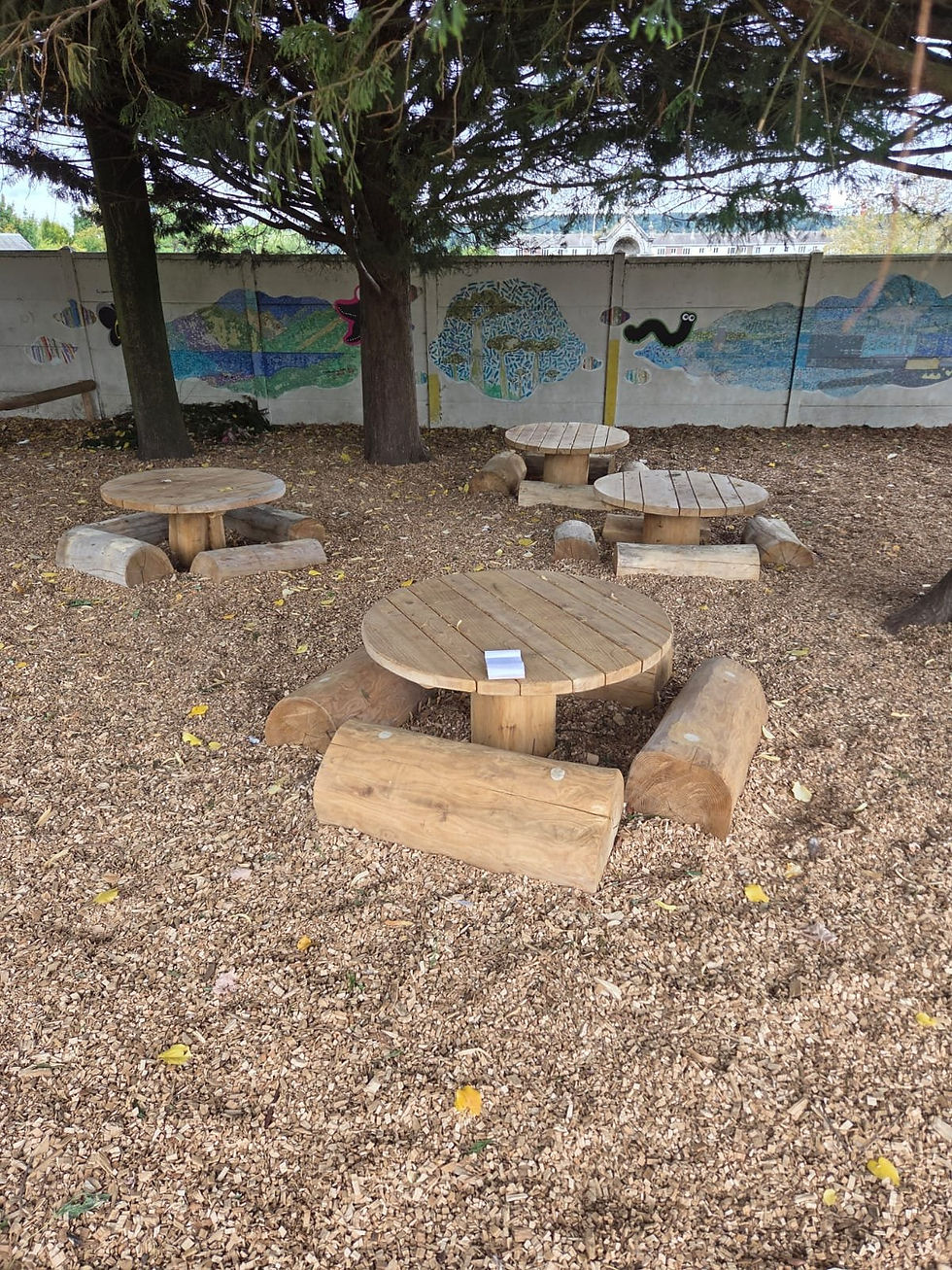
In material terms, it changes the playground. A tarmac playground is not a classroom: it needs seating, tables, platforms and tiered seating, shade and living soil. That is the programme of the Paris “Oasis” schoolyards, launched in 2017 — 203 playgrounds transformed to date, 360 targeted by 2030 — with de-paving, planting, locally sourced furniture and co-design with the children.
This return to soil, shade and water calls for a consistent material. Putting plastic or treated timber into a playground that has just been de-paved contradicts the approach, and a teaching team sees it immediately. Untreated solid timber is the simple answer: it weathers without maintenance, can be repaired piece by piece, ends up as firewood, and brings no product into places where children sit, climb and eat.
Then there is the practical constraint, the one that decides the purchase: an outdoor class goes ahead in all weathers. Benches, tables, logs, platforms and planting edges stay outside all year round, with no cover and no winter storage. That is the specification of a use class 4 timber — and it rules out from the start any furniture that would have to be brought in, repainted or re-treated every summer.

Anchoring and maintenance: what happens at ground level?
The critical zone of a timber post is at ground level, where moisture, oxygen and spores come together: a structure breaks there, never halfway up. A post set in concrete requires the concrete to stop below finished ground level or to form a sloping collar — a weathering — that sheds water outwards, on a bed of free-draining gravel. Never a hollow that holds water at the foot.
A raised post base lifts the wood a few centimetres off the ground and lets it dry between showers: it is the most durable installation, provided the base and bolts create no protrusion or edge in the fall zone. The depth of a post set in the ground is worked out as for any loaded post, of the order of a quarter to a third of the height above ground, to be confirmed by the equipment manufacturer's calculation. Since robinia is acidic (pH ≈ 4.5), stainless steel is essential: see “Screws and fixings for robinia”.
Part 7 of EN 1176 sets out three levels of inspection: a frequent routine visual inspection, which picks up vandalism and recent damage; an operational inspection every one to three months depending on use; and an annual main inspection, by a competent person, covering foundations, rot and corrosion. A doubtful post is replaced on its own, without taking down the structure.
Where robinia loses in a tender, and what we supply from Teiu
Three objections come up in tenders, and they are well founded. The purchase price of robinia is well above that of pressure-treated pine, even though the cost per year of service works the other way. Long, perfectly straight lengths are rare: the tree grows crooked, and beyond 6 to 8 m straight pieces become expensive. Finally, the appearance varies from piece to piece — colour, growth rings, small knots.
A final word on what we do and what we don't do, because the confusion is common. We don't build installations and we don't make play equipment: that is the job of distributors, landscapers and play equipment manufacturers, who design, install and carry the responsibility under EN 1176. Our role is upstream. From Teiu, we supply more than 25 countries with the materials these projects need — sanded posts, logs, boards, decking and end-grain wood pavers — under certificate FSC® C153588. And our joinery workshop at the factory lets us go further than raw material: pieces cut to length, chamfered edges, drilling to a drawing, tops and components prepared to order. In other words, we deliver ready-to-install pieces to the people whose job it is to install them.
Key points
· Robinia heartwood reaches durability class 1-2 (EN 350) and holds use class 4 (EN 335) with the wood alone.
· EN 1176 governs the safety of equipment and prescribes no species; EN 1177 covers impact-absorbing surfacing.
· Fresh bark contains robin; fully debarked wood is inert, and that is what a specification should require.
· The foot of the post is the critical zone: a sloping weathering or a raised post base, never a hollow, stainless steel fixings.
· Higher price than pressure-treated pine, long straight lengths rare, variable appearance: the three limits.
Frequently asked questions
Does EN 1176 require a particular species of timber?
No. The EN 1176 series sets requirements for structural strength, absence of sharp edges and splinters, dimensions that avoid head, finger and clothing entrapment, stability and safety zones, as well as an inspection regime. It contains no list of approved species, and neither does EN 1177 on impact-absorbing surfacing. The choice of robinia belongs in the technical specification, which can require natural durability class 1-2 (EN 350) and no chemical treatment.
Can a child get splinters from sanded robinia play equipment?
The risk exists on any timber structure outdoors, but it remains low on well-prepared robinia. Robinia is a dense timber, around 740 kg/m³, whose sanded fibres do not lift the way those of a soft softwood do: the surface does not go fluffy in its first winter. What produces splinters is chipping after an impact and areas damaged by vandalism. A light rub-down with fine-grit paper puts an area right.
Should wooden play equipment be varnished or treated to protect it?
Not with robinia. The heartwood holds use class 4 (EN 335) without any product, and no fungicide improves a timber already rated durability class 1-2 (EN 350). Film-forming finishes — varnishes, thick stains — are actually unsuitable for a playground: the film cracks under impact, peels off in patches and traps moisture. A penetrating oil remains an option to keep the honey colour, but that is an aesthetic choice that commits you to re-applying it every two to three years.
Is robinia a toxic risk for children?
The debarked wood used in a playground is inert: it contains no added biocide and releases nothing on contact with hands or mouths. Robin, the substance concerned, is found in the fresh bark, leaves, seeds and young shoots — the living part of the tree, not the sanded heartwood of a post. The practical rule is to specify fully debarked pieces; the veterinary sources are in the FAQ of “Robinia fencing and cleft palings – choosing by use”.
What is checked every year on a robinia play structure?
The annual main inspection set out in Part 7 of EN 1176 covers general condition, foundations, the effects of weather, rot and corrosion. On timber, four points account for most of it: probing with a spike at ground level and just below, to detect a spongy core; play in the joints, tested by rocking the structure; splits opening upwards, which hold water; and the tightness of the stainless steel fixings. Every inspection is recorded in the logbook.
Further reading
Reference guide: “Robinia outdoors – the complete guide”.
See also: “Vegetable gardens, raised beds and edging – robinia in ground contact”, “Robinia or pressure-treated pine (use class 4) – the comparison”, “Is robinia an ecological timber?”, “Screws and fixings for robinia”.
Our products: Sanded posts · Round stakes · Edged boards.
Contact: council grounds teams and play equipment manufacturers, send us your specification.
Disclaimer. Non-contractual article, provided for information only (photos and drawings included). Robinia is a natural material: the values given are orders of magnitude and may change without notice; in case of discrepancy, only the product’s technical data sheet and the general terms of sale apply. Always check the regulations that apply to your project.
© Xylo Impact SRL — all rights reserved, products marketed under the Acacia Poles brand. Any reproduction, even partial, is prohibited without prior authorisation.


Comments